Antonio Ocaranza Fernández
The combination of the assassination of Uruapan mayor Carlos Manzo and the government’s reaction to the November 15 demonstration in Mexico City has put President Claudia Sheinbaum’s Administration on the defensive. There are five aspects of the recent public conversation that are fueling narratives that are potentially dangerous for the government: the ability of states to solve problems, insufficient action against organized crime, the limitations of intelligence efforts, the political centrality of Mexico City, and Morena party politicans’ indolence in the face of governance challenges.
1.- Local government incompetence. The challenges of November were preceded by floods that affected five states in October and exposed the president to direct expressions of anger over the indolence and mediocrity of some state governments. The governments of Michoacán and Mexico City also showed a lack of skill in dealing with the crisis triggered by the attack on Manzo and the protests. In two months, the president has had to step in to resolve the shortcomings of state leaders from her own party.
2.- Permanent insecurity: despite the official discourse highlighting improvements in security and the real blows against certain criminal groups, the dominant perception in the country is that organized crime controls the daily lives of millions of citizens. According to Mexico´s National Statistics Institute (INEGI), in September 2025, 63% of the adult population in 91 urban areas considered it unsafe to live in their city. The murder of Carlos Manzo—perpetrated despite the federal government’s protection—exacerbated that feeling and exposed the vulnerability experienced by many Mexicans throughout the country.
3.- Intelligence efforts without results. The president has insisted that intelligence is the cornerstone of her security strategy and has promoted legal reforms to strengthen it. However, the social perception is that intelligence services continue to act reactively, not preventively. Despite obvious threats, they failed to prevent the attack on Manzo and have not been able to arrest the leaders of the violent Black Block protesters who repeatedly show up at demonstrations in the capital. Nor have they been able to clearly identify the political or economic interests that could be behind these groups. Not to mention arresting major drug lords, such as “El Mencho,” who continue to terrorize large areas of the country and are rarely mentioned. The gap between the rhetoric of using “modern intelligence” models and the actual results generates skepticism.
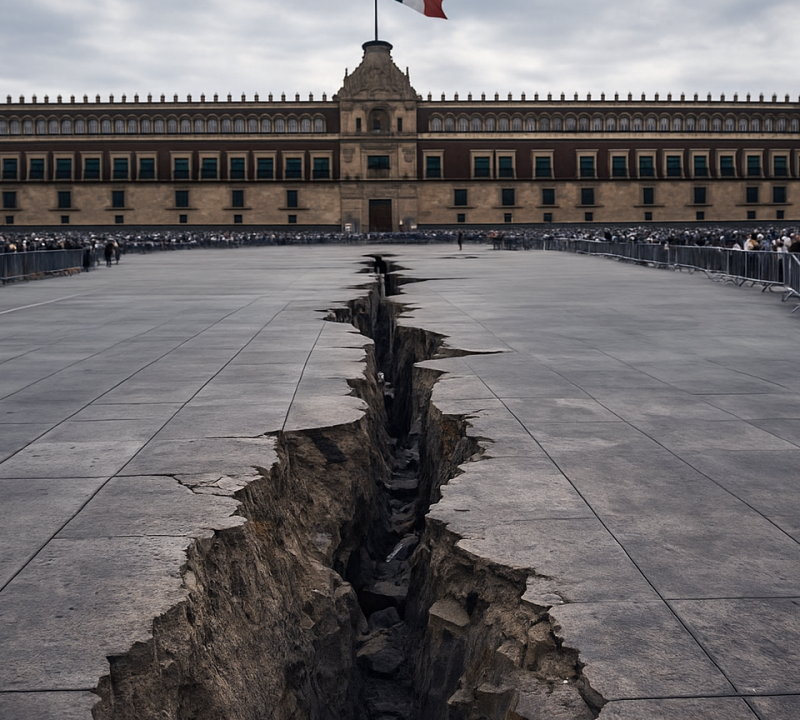
4.- The centrality of Mexico City. Although Mexico’s capital has its own government, it is inevitable that what happens there directly affects the president. The capital is the seat of the federal government, and for many citizens, the boundaries between the two levels are blurred. In addition, Sheinbaum was the most recent head of government, which makes her jointly responsible—in the public perception—for the problems that are now manifesting themselves in the streets. After years of protests accompanied by organized violent groups and the recurring actions of the Black Bloc, it is implausible that the authorities claim to be unaware of who the leaders are or whose interests they represent. If the capital continues to show weakness in controlling public spaces, the damage will not only be to the local government: it will inevitably filter down to the presidency.
5.- Morena Party ‘s indolence. The president´s party reactions to national challenges represent another obstacle for her. Governors who shirk their responsibilities, parliamentary leaders who are slow to close ranks, and speculation about officials involved in financing or organizing the Black Bloc fuel the perception that there are actors within the movement itself who have no incentive to facilitate governance. Although the official discourse focuses on pointing the finger at far-right groups or opponents, much of the erosion comes from within.
The real challenge for Claudia Sheinbaum lies not in the opposition or in the streets, but in the state’s inability to protect its citizens and the indiscipline of her own movement. The narratives that are taking hold today—an overwhelmed government, insufficient intelligence, a city out of control, and a party that is not keeping pace—may have a long life. The president still has time and political capital to get back on track. But November left a clear warning: what will test her government is not the opposition but the cracks that are opening up within her own house.