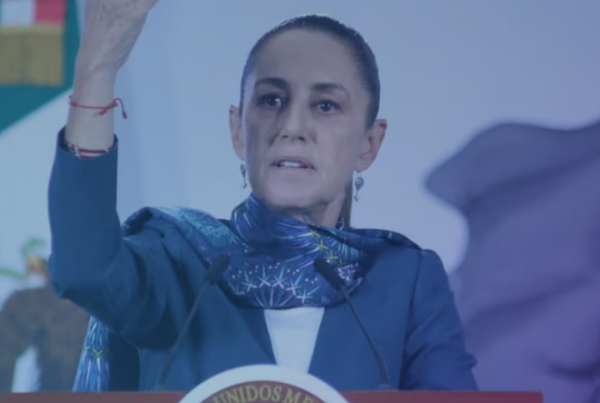
President Claudia Sheinbaum has argued that the decision not to seek an extension of the USMCA’s current term rests solely with the United States, and that her government has done everything within its power to preserve the agreement. The first claim is difficult to dispute. The second is far more debatable and deserves closer examination.
The history of the North American Free Trade Agreement (NAFTA) negotiations in the early 1990s shows that Mexico did not defend its interests in the United States simply by negotiating with the White House or Congress in Washington. Mexican policymakers understood that the real battleground extended well beyond the negotiating table. Winning over American public opinion and influential constituencies was just as important.
Between 1990 and 1993, Mexico launched the most ambitious public diplomacy campaign in its modern history. The government hired law firms, public relations agencies, and lobbyists; mobilized its diplomatic and consular network; strengthened ties with business leaders, universities, think tanks, Mexican American organizations, the media, religious leaders, and community groups; and promoted a simple yet compelling message: a trade agreement with Mexico would also benefit the United States. President Carlos Salinas de Gortari personally led this effort, making frequent visits to Washington, New York, and politically strategic cities such as Chicago, Los Angeles, San Diego, Houston, Miami, and San Antonio.
The objective was to build a broad coalition of interests capable of creating a positive atmosphere so as to allow both Congress and the White House to support NAFTA’s approval.
Three decades later, that vision has virtually disappeared from Mexican foreign policy. There is little evidence of a comparable effort to persuade the American public that weakening the USMCA would also harm U.S. workers, consumers, businesses, and border communities.
The difference goes far beyond a change in style. It reflects the way the governments of President Sheinbaum and former President Andres Manuel López-Obrador understand foreign policy, and it exposes three major constraints that have prevented them from developing a robust public diplomacy strategy in the United States: 1.- limited interest in international affairs, 2.- deep concern over U.S. interventionism in Mexico, and 3.- the constraints imposed by its austerity policies.
- Limited interest in international affairs. Although President Sheinbaum has shown greater willingness than her predecessor to participate in international forums, she continues to embrace the notion that “the best foreign policy is domestic policy.” Yet foreign policy cannot be reduced to the expectation that domestic achievements will speak for themselves abroad. International influence is also built through political engagement, personal relationships, and strategic communication.
- An obsession with interventionism. Influencing Washington requires active participation in its political ecosystem: identifying allies, building trust with members of Congress, governors, business leaders, and civil society organizations, investing time in meetings, and sustaining a continuous dialogue. Yet a government that routinely condemns any attempt by foreign actors to influence Mexican politics is unlikely to feel comfortable employing the same strategy in the United States. The result is a far more passive diplomacy than current realities—and the American political system itself—demand.
- Crippling austerity. Public diplomacy requires resources. It means hiring experts in strategic communications, lobbying, and public relations; producing research; organizing events; and strengthening the work of embassies and consulates. All of these activities require investments that the current government of Mexico either fails to appreciate, regards as unnecessary, or considers politically difficult to justify.
None of this guarantees that Donald Trump would have changed his position on the USMCA. But governments that understand how Washington works know that success does not depend on persuading a single individual. It depends on building a network of allies capable of raising the political cost of decisions that run counter to its’ interests.
President Sheinbaum is right when she says she cannot control decisions made in Washington. No Mexican government can. What is within her government’s power is to develop a strategy capable of influencing those who shape White House policy toward Mexico. That is the difference between a diplomacy that merely reacts to events and one that seeks to shape them—between trying to influence U.S. decisions and simply resigning oneself to living with their consequences.
In Mexico’s relationship with the United States, negotiation has always been indispensable. But persuasion has often been even more important. Mexico once understood that lesson. Unfortunately, its government now seems to have forgotten it.